What is a Base?
When the price moves sideways and consolidates after an uptrend/downtrend, it rests before the next potential move. This price consolidation is called a ‘Base’. Essentially, within a base the stock is changing hands, as new buyers accumulate.
Timeframes: the base can form on different timeframes, on hourly, daily, weekly or monthly charts.
Duration: the longer the base, the longer the rest period, and more the energy accumulated for the next potential move.
Tightness: the base formation that shows tightness i.e. consolidation within a narrow price range, the more meaningful it becomes for traders as it signals that sellers have been exhausted and buyers are steadily accumulating the stock. Generally, significant moves follow after a stock breaks out from a tighter and longer base.
Number: A stock can form another base, before resuming the uptrend. In this journey, from start to a medium/long term top, the stock can form multiple bases. Generally, traders become cautious when the stock breaks out from Base-3 onwards, as it becomes risky since the buyers might be running out of strength to keep pushing the stock higher. Higher bases can be followed by a significant price correction, which in some cases can remain in a downtrend for over a decade!
Example: in the chart below, IRFC forms a base after an uptrend. The price volatility is low, showing tightness within the base. This shows Institutional buying strength, that eventually pushes the stock higher 150% before it rests to form another base.
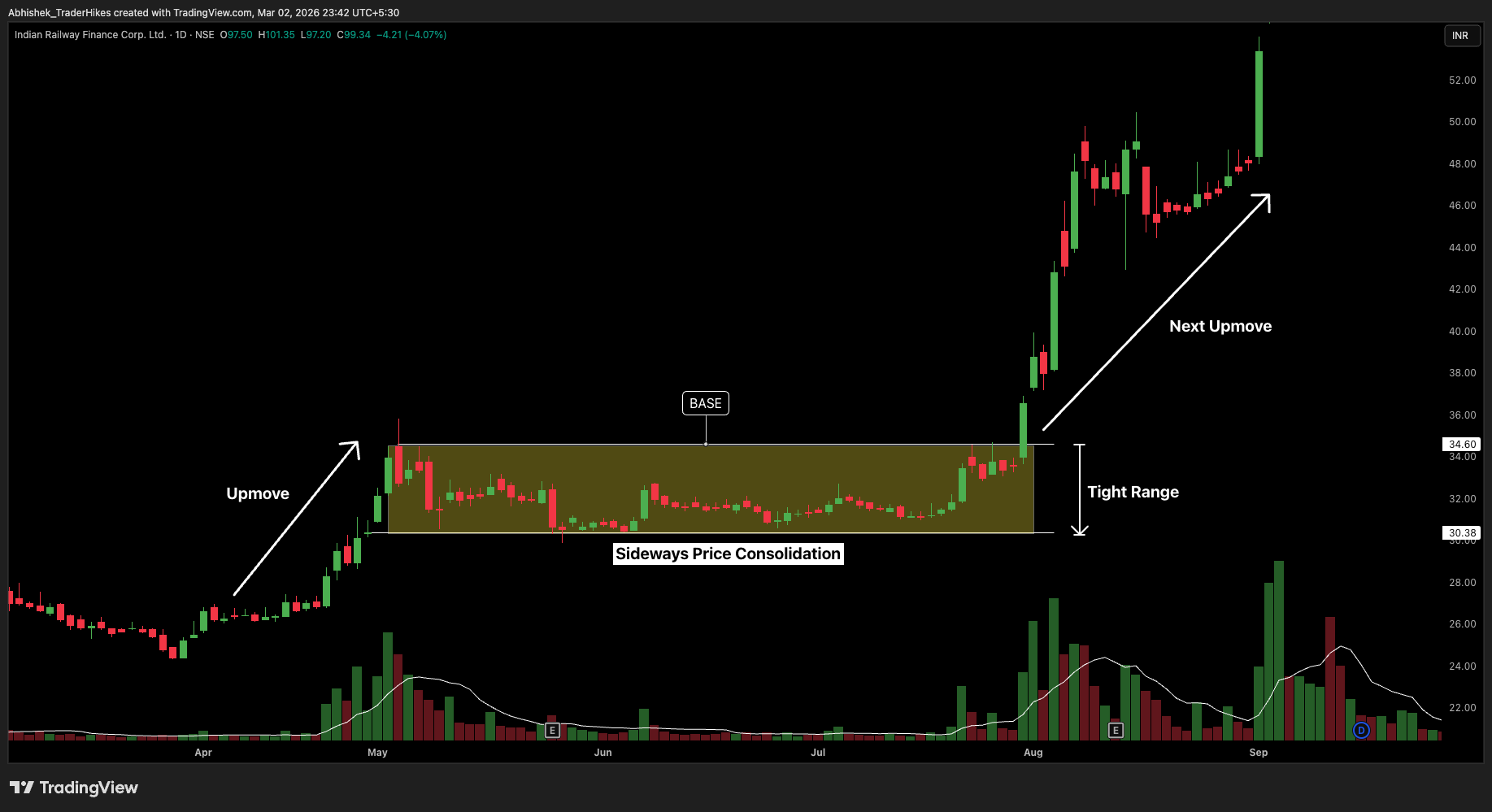
Chart: TradingView
Look at the chart of IRFC below, it created 4 Bases i.e. 3 more bases after the one that we discussed above, and finally turned downtrending after creating a price top.
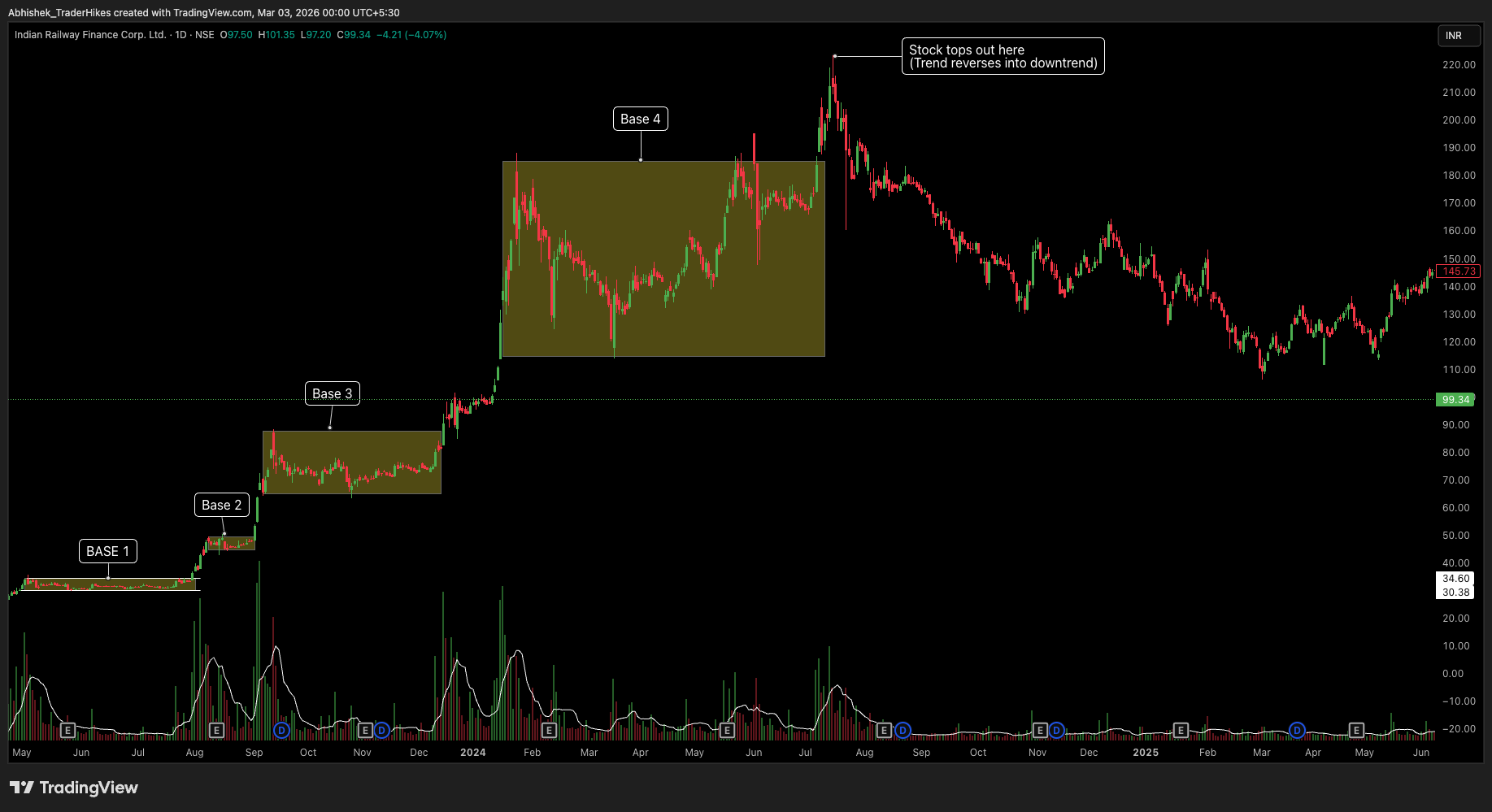
Chart: TradingView
Did you notice?
Bases 1-3 show tight price consolidation, that were subsequently followed by a strong uptrend.
Base 4 shows loose price consolidation i.e. price range widened, showing distribution by the Institutions before the stock turns downtrending. Finally, when the stock broke out from the base, it couldn’t go higher, as the stock ran out of gas. No more buyers! What follows next? Selling. Ultimately, stock reverses the trend into a downtrend.
As a Trader, you should always look for tight price action within the base, as it shows stock is getting accumulated. When you see loose consolidation with wild swings within the base on high volume, that’s an alarm to become cautious as the stock may turn downtrending.
See it in action:
When you read the DeepDive reports next time, you should keep your eyes open as look for price consolidation/base and the characteristics (duration & tightness).